Precautions for the Selection and installation of Thermal Fuse
-
Use of Appropriate Thermal Fuse :
Ensure that the thermal fuse selected is suitable for the specific application and device. The use of an incorrect type or specification may result in malfunction or pose safety risks.
-
User Responsibility for Selection and Installation :
The selection and proper installation of thermal fuse is the sole responsibility of the user. It is essential to select a thermal fuse that meets the precise specifications required for the intended equipment and to install it in an appropriate location. The thermal fuse must be evaluated under actual operating conditions to verify its performance and reliability. Thorough testing should be conducted to confirm proper functioning within the end-use environment.
-
Thermal Fuse Rating :
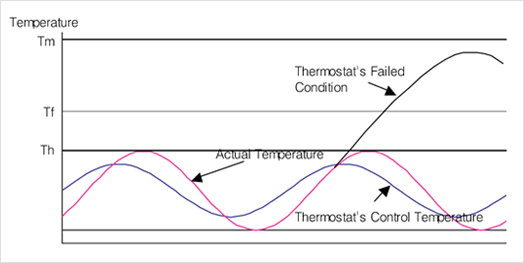
The thermal fuse should be selected with a rated functioning temperature that provides sufficient margin above the maximum expected ambient temperature during normal operation. Temporary temperature overshoots must also be taken into account. If the thermal fuse is rated too low, it may result in frequent nuisance openings, which can lead to shrinkage of the internal pellet or reduced thermal fuse life due to thermal stress. Insufficient thermal margin can shorten the fuse's service life and negatively impact overall reliability. Each thermal fuse is specified with ratings for current, voltage, functioning temperature(TF), holding temperature (TH), and maximum temperature (TM). The thermal fuse must be used within these specified limits.
-
Thermal Fuse Body Temperature :
As current flows through the thermal fuse, the temperature of the thermal fuse body increases. When carrying higher current, the body temperature can rise significantly above the ambient temperature. It is essential to measure the thermal fuse body temperature during testing to ensure that the temperature rise due to current does not cause the thermal fuse to exceed its specified holding temperature (TH) limit.
Proper Installation and Connection of Thermal Fuse
※ Thermal Fuse Installation Guidelines
-
Thermal Fuse Mounting Location :
When installing a thermal fuse, it is crucial to select a position within the device where the thermal fuse will not be subjected to stress from internal vibrations or movement of other components. The thermal fuse should be mounted in a location where it can directly sense heat from the source or where temperature rise occurs first during abnormal conditions—such as thermostat failure, cooling fan malfunction, or overload—so that it can quickly detect overheating.
It is important to note that a thermal fuse may not operate correctly just because the surrounding air is hot. Therefore, ensure that the fuse itself can reach the necessary activation temperature.
Using tools like infrared thermal imaging cameras or thermocouples to identify areas with significant temperature differences between normal and fault conditions is recommended for optimal placement.
Additionally, after activation, the ambient temperature around the fuse must not exceed its maximum allowable temperature. Thermal fuse is designed to minimize self-heating and accurately detect ambient temperature. Improper mounting can lead to malfunction. Under
normal conditions, the thermal fuse should not overheat excessively, but it must be capable of quickly detecting and responding to overheating in abnormal situations.
-
The thermal fuse must be installed to monitor only the intended heat source :
If there are other heat sources nearby that could cause the thermal fuse to receive unintended heat, be sure to use thermal shielding materials to block external thermal influence. For example, when attaching a fuse near a heater, avoid configurations where the heating element directly heats the fuse. While the thermal fuse should be positioned to monitor the heating element, care must be taken to prevent direct heat transfer from the element to the thermal fuse.
-
Maintaining a Consistent Temperature Environment :
Thermal fuse operates most accurately when the temperature at the installation location remains consistent. For example, if a thermal fuse is mounted on a metal case and heat is transferred from only one side, the internal part of the fuse may heat up abnormally and trigger too early. To prevent this, install the thermal fuse so that both leads are placed in a similar and consistent temperature environment. If one side is significantly cooler, it may cause malfunction.
Thermocouples may be attached to both fuse leads to monitor the thermal gradient.
To ensure balanced heat transfer to the fuse body, it is advisable to position the insulated (epoxy) lead closer to the heat source. In contrast, placing the metal lead adjacent to the heat source can result in a thermal gradient across the thermal fuse body, potentially leading to premature activation or reduced thermal fuse longevity.
* Thermal gradient: the variation in temperature across a material or space, indicating a difference in temperature between two or more points.
※ Precautions When Processing Thermal Fuse Lead Wires
-
Bending the Lead Wires :
The lead wires of a thermal fuse are made of copper, making them easy to bend. However, excessive sharp bending or repeated bending can weaken or break the wire. Therefore, the wires should be bent gently at an appropriate angle.
-
Bending Location (Maintaining Minimum Distance) :
On the molded side (where the lead wire is sealed into the thermal fuse body), the wire should only be bent at a point at least 4mm away from the thermal fuse body. Bending too close to the sealed area may damage the seal and affect the proper functioning of the fuse. Similarly, on the non-molded side, bending must also be done at least 4mm away from the thermal fuse body to prevent damage. Strong bending or twisting too close to the body can damage internal components, potentially causing the thermal fuse to operate at a temperature lower than its rated value, or to fail entirely.
Use of Tools and Damage Inspection: When bending the lead wires, it is recommended to use tools such as pliers or a jig (a tool designed to bend wires at a specified position and angle). After processing, be sure to inspect the wires for any signs of damage, such as cuts, dents, or cracks.
※ Precautions When Connecting Leads to a Thermal Fuse
-
Avoid Damage to the Thermal Fuse Body :
When connecting external wires, ensure that no stress, cracks, or deformation is applied to the molded section or main body of the thermal fuse. Thermal fuse is highly sensitive component, and even minor physical damage can compromise its performance. They may also be adversely affected by mechanical stress, heat, excessive moisture, or corrosive environments containing sulfur dioxide. Handle with care at all times. It is strongly recommended that a qualified technician inspect the lead wires, molded area, and thermal fuse body before and after the connection process. Do not use any thermal fuse that shows signs of damage.
-
Use of Connectors is Recommended :
For external wiring, it is strongly advised to use splice connectors (for wire-to-wire connections) or terminal connectors (for equipment connections). Ensure that no excessive force is applied to the fuse during the connection process. All connections must be mechanically secure and capable of withstanding a minimum tensile strength of 5kg.
-
Keep Lead Wires Short and Resistance Low :
The lead wires connected to the thermal fuse should be kept as short as possible, preferably under 50 cm. The longer wires increase electrical resistance, which may lead to additional heat generation at the thermal fuse and result in a shortened service life.
- Recommended wire gauge: AWG 18 or 20 (Low resistance)
- Recommended wire type: flexible stranded wire
- If a single-core wire is used, bend it suitably in advance.
-
Electrical Connection Precautions :
If the electrical connection is poor, the connector or connection point may overheat. Therefore, it is important to use connectors made of materials with low electrical resistance and to ensure that the thermal fuse body is not exposed to heat. Additionally, care must be taken during the connection process to avoid any damage to the thermal fuse body.
※ Precautions During Soldering
-
Minimize Heat Transfer to the Thermal Fuse Body :
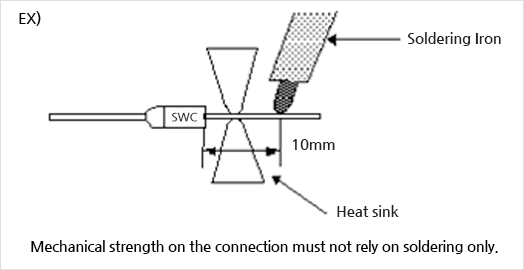
Whenever possible, solder the wires at points away from the thermal fuse body. Minimizing heat transfer to the thermal fuse body during soldering prevents issues such as molding or body damage, and internal circuit disconnection.
-
Pre-Soldering and Heat Blocking Measures :
To reduce soldering time, it is recommended to pre-solder the wires before connecting them to the fuse. During soldering, hold the wire near the thermal fuse with pliers or a similar tool to absorb heat and block heat transfer to the thermal fuse. Be careful not to apply heat for more than 3 seconds.
-
Mechanical Strength :
Physical forces applied to the thermal fuse should be limited. The lead wires must not be subjected to tensile forces exceeding 2 kg or compressive forces exceeding 0.5 kg. Also, do not apply shocks or excessive force to the thermal fuse body.
※ Precautions During Welding
- When performing electric welding, be especially careful to ensure that welding current does not flow through the thermal fuse body.
- If current passes through the thermal fuse internally, it can damage internal components, causing malfunction or complete failure.
- If welding near the thermal fuse is necessary, consider grounding positions and current paths carefully.
- Avoid overheating the thermal fuse during welding. The connection point must be at least 5mm away from the thermal fuse body. Use tools to hold the leads near the case to allow heat dissipation.
※ Precautions During Molding
-
The thermal fuse’s epoxy is vulnerable to boiling water, organic solvents, acidic liquids, and similar substances. Therefore, strictly control the work environment to avoid exposure to these
substances.
-
It is important to use neutral or non-reactive materials suitable for molding operations.
Reliability Assurance and Testing
Thermal fuse is not designed to last indefinitely(Consumable Component). Although its internal components are engineered for durability, the actual service life depends heavily on the operating conditions. Frequent exposure to temperatures near the rated operating temperature can accelerate degradation. To determine the longevity of a thermal fuse in a specific application, it is recommended to install the fuse in the actual product and conduct real-world testing.
-
Reliability Testing Considering Thermal Fuse Lifespan :
Prolonged exposure to high temperatures can gradually deteriorate the internal fusible material, leading to reduced operating reliability. Therefore, reliability testing that accounts for the expected service life under intended environmental conditions is essential.
-
Post-Installation Inspection of Thermal Fuse :
After installing a thermal fuse, do not pull, twist, or push the leads. Even minor mechanical stress can alter the internal structure and prevent proper operation. Thermal fuse is sensitive to mechanical and thermal stresses that may occur during installation or transportation.
- Visual Inspection : Check for any visible damage to the thermal fuse body.
- Resistance Check : Measure the electrical resistance of the thermal fuse and compare it to the pre-installation value, or simply verify continuity.
- (Optional) X-ray Inspection : If equipment is available, use X-ray imaging to detect any internal damage to the thermal fuse.
Sample Functional Testing : Select a sample of thermal fuse from the batch and confirm proper activation.
Fault Condition Simulation : Simulate failure scenarios—such as thermostat malfunction or blocked airflow—and ensure the thermal fuse activates reliably. If multiple thermal fuses are used in a system, verify that each operates independently and that system safety is maintained.
Testing Under Real Operating Conditions : Operate the actual product and monitor both the maximum steady-state temperature and any overshoot. Include environmental variables such as current load, airflow, and vibration to simulate realistic usage. It is also important to observe how much the temperature rises after the thermal fuse opens, as excessive overshoot may lead to insulation breakdown or unintentional reconnection.
*overshoot: it refers to the temporary temperature rise beyond the intended steady-state or limit temperature, which may compromise the integrity of the thermal fuse or cause malfunction.
Storage of Thermal Fuse
The way thermal fuse is stored can affect their performance. Please keep the following points in mind
-
Store thermal fuse in a cool and dry place. Do not expose them to excessive heat or humidity before use. They should be kept in sealed packaging and away from direct sunlight.
-
Thermal fuse contains silver-plated components, which can be damaged by sulfur in the air. This may make markings on the thermal fuse difficult to read or interfere with soldering. Therefore, do not store them near materials that can emit sulfur, such as cardboard or rubber.
-
Do not use thermal fuse in environments containing sea breeze, sulfur dioxide gas, nitrogen oxide gases, ammonia gas, or formic acid. High humidity or submersion in liquids is also unsuitable. The thermal fuse casing is made of a brass alloy, which can corrode or crack under such conditions. This may cause the thermal fuse to activate at a lower temperature than intended or fail to activate at all.
-
Double packaging : If thermal fuse needs to be stored in cardboard boxes, first place them in a tightly sealed plastic bag, such as a polyethylene bag.
-
For long-term storage, replace paper boxes with plastic containers or polyethylene (PE) bags.
Materials like paper or rubber can emit gases that cause discoloration or damage. It is
recommended to store products in their original packaging or in polyethylene bags, at 20°C ± 10°C with a relative humidity below 60%.
-
Discoloration
Thermal fuse is silver (Ag) plated, so discoloration of the fuse body or lead wires may occasionally occur.
This discoloration is simply a change in the appearance of the silver surface and does not affect the electrical or functional performance of the product. Measuring the resistance of discolored products shows that it remains the same as before discoloration. The discoloration is limited to the surface of the thermal fuse and does not impact the internal structure or performance. The rate of discoloration can vary depending on the storage environment and external conditions, occurring slowly, rapidly, or continuously over time.
-
Causes of Discoloration
Discoloration tends to occur more quickly in polluted or poor air quality environments. It happens when silver reacts with sulfur compounds and moisture in the air, forming a sulfide film on the
surface. When the sulfide layer is thin, the color changes from yellow → brown; when it becomes thicker, it appears black.
Discoloration has been especially noted in products stored for extended periods in areas where sulfur-containing gases such as automobile exhaust are present, combined with high humidity.
-
Precautions Regarding Oxidation (Discoloration) Removal
While it is technically possible to remove the oxidation film from discolored products through chemical methods, this is not recommended, as it may affect the operation of the thermal fuse. Additionally, even if the oxidation is removed, it may reoccur over time.
-
Handling Precautions
Avoid handling the product with oil-contaminated gloves, sweaty hands, or hands with cosmetics, as these can accelerate the discoloration or oxidation of the silver-plated surface. If it is difficult to completely eliminate environmental factors, using protective packaging or anti-tarnish agents can help prevent silver oxidation.
Limitations on the Use of Thermal Fuse
-
Single-Use Safety Device :
Thermal fuse is a single-use safety component. Once activated and the circuit is interrupted, they cannot be reused and must be replaced with a new thermal fuse. Each thermal fuse is designed to operate only once upon reaching its specified temperature. Installation, removal, or replacement of thermal fuse requires proper knowledge and experience. If you are not familiar with such procedures, do not attempt them yourself—consult a qualified technician or specialist.
-
Voltage and Current Limitations :
Always use thermal fuse at voltage and current levels below its rated value. Exceeding the ratings may cause internal components to fuse together, resulting in failure.
-
Prohibition of Parallel Connections :
Do not connect thermal fuse in parallel to increase current capacity. Also, avoid exposing the thermal fuse to continuous overcurrent or overvoltage conditions, as this may damage internal contacts and compromise functionality.
-
Avoid Use in Liquids or High Humidity :
Do not use thermal fuse in environments where they may be submerged in liquids or exposed to humidity levels exceeding 95%. Such conditions can impair proper operation.
-
Applications Where Thermal Fuse Must Not Be Used
The following are applications where the use of thermal fuse is strictly prohibited. If use in such environments is absolutely necessary, please consult our company or an authorized distributor in advance
: Engine control systems of aircraft, ships, automobiles, or other vehicles, Nuclear power facilities, Life-support medical devices, Spacecraft or satellites etc.
-
Disclaimer
We've done our best to provide accurate information here. However, Sungwoo Industrial Co. is not responsible if you misuse these instructions or if something goes wrong due to factors beyond our control. This document is for informational purposes only. If you have any questions or need more clarification, please contact us directly.
This information is based on the latest data available as of October 2025, and is subject to change without notice.
Always refer to the most recent documentation for the most up-to-date information.
 Technical DataPrecautions